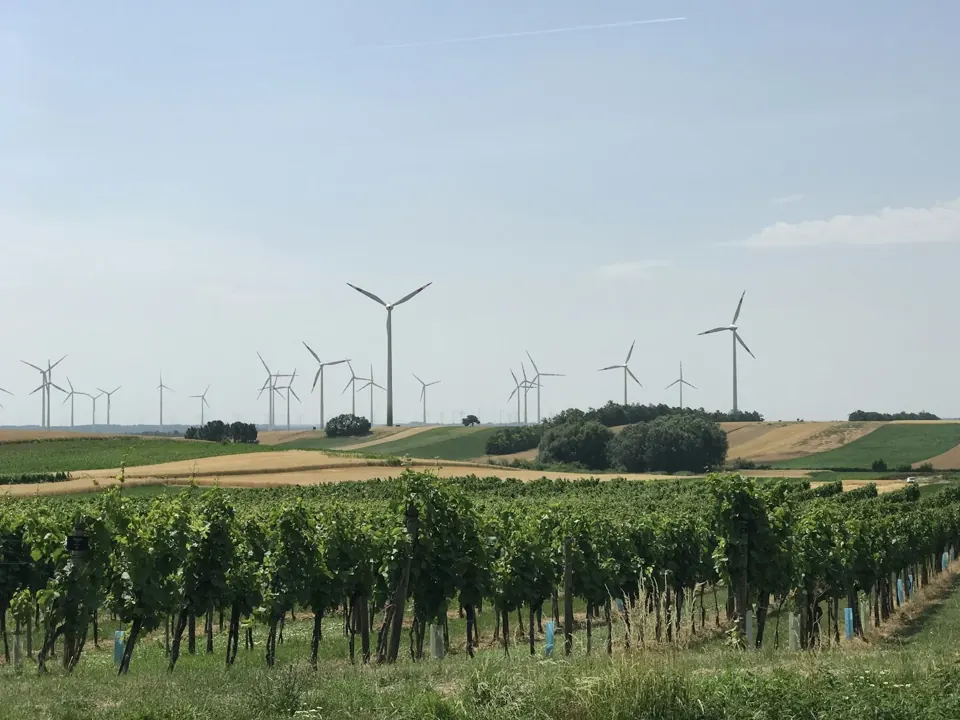
Picking a green electricity plan has become a routine decision for households in France. ADEME reports that nearly 70% of plans sold in 2025 carry a green claim, yet only a fraction actually finance new renewable generation. This guide explains, using French official sources (ADEME, RTE, CRE, Médiateur national de l'énergie), how guarantees of origin work, what the VertVolt label actually certifies, which providers offer genuinely renewable plans, and how to switch without any power interruption. The page is written with French residents and expats in mind, including landlords, tenants and holiday-home owners.
1. Green Electricity: the Official Definition
Green electricity in France is generated from renewable sources, that is from resources that replenish at a rate comparable to or faster than consumption. Five technologies are considered renewable in the French regulatory framework: hydropower, onshore and offshore wind, photovoltaic solar, biomass (wood, agricultural waste, biogas) and geothermal. All emit very little CO₂ when generating power, in contrast to coal, gas or oil.
One key point matters for any expat newly arrived in France. The electricity that comes out of your socket is physically identical regardless of which supplier you have signed with. The transmission grid (RTE) and the distribution grid (Enedis on 95% of the territory) are unified. Electrons from nuclear, hydropower, wind, solar and gas mix as soon as they enter the network. Picking a green plan does not change the nature of the current at home. What it does change is the procurement strategy of your supplier, who commits to buying an equivalent amount of renewable electricity on your behalf, verified by a mechanism called Guarantee of Origin.
That mechanism, not marketing language, is what tells a real green plan from a green leaf printed on the bill.
2. The French Electricity Mix in 2024 (RTE data)
According to the 2024 annual balance published by RTE (Réseau de transport d'électricité), France produced about 540 TWh of electricity. The breakdown by technology is roughly as follows.
| Source | 2024 Share | Renewable? |
|---|---|---|
| Nuclear | ≈ 65-70% | No (low carbon) |
| Hydropower | ≈ 12-14% | Yes |
| Wind (onshore + offshore) | ≈ 10-12% | Yes |
| Solar photovoltaic | ≈ 4-5% | Yes |
| Bioenergy (biomass, biogas) | ≈ 2% | Yes |
| Gas and other fossil | ≈ 5-7% | No |
The total renewable share (hydro + wind + solar + bioenergy) is therefore around 27-30% of French production. Nuclear remains dominant and gives France one of the lowest carbon intensities for power in Europe (around 50 g CO₂/kWh). The Programmation pluriannuelle de l'énergie (PPE) targets 40% renewables in the electricity mix by 2030.
This matters: even without a green plan, French electricity is already very low-carbon compared with the European average (around 250 g CO₂/kWh). Choosing a green offer is primarily about funding new renewable capacity, not about decarbonising your own consumption.
Wind
≈ 22 GW installed end-2024
Solar
≈ 22 GW installed end-2024
3. Guarantees of Origin: How the System Works
The Guarantee of Origin (GO) is a European electronic certificate regulated by the European Energy Certificate System (EECS). It is the only official document that proves the renewable origin of a megawatt-hour of electricity.
The principle: 1 MWh = 1 GO
- A renewable generator (wind farm, solar plant, hydropower station, biogas plant) injects 1 MWh of electricity into the grid.
- The national registry operator (EEX, formerly Powernext) issues a corresponding GO.
- The GO is offered for sale. A supplier buys it to back its green plan.
- When used to cover a customer's consumption, the GO is cancelled to prevent double counting.
The cost of a GO
GO prices on the European market vary by origin and technology. A Scandinavian hydropower GO trades at around EUR 1 to 3 per MWh. For a typical household consuming 5,000 kWh per year, that adds only EUR 5 to 15 in supplier cost. This explains why some standard green plans can be sold at the same price as a non-green plan.
Limit: decoupled GOs
A GO can be bought separately from the underlying electricity. A supplier may buy wholesale electricity (including nuclear and fossil sources) and then offset with cheap GOs from Norwegian dams. The offer is legally green. The real link to French renewable generation is weak. The VertVolt label corrects exactly this loophole.
4. ADEME VertVolt Label: Two Tiers
Launched in 2021 and now in its fourth version (2026), the VertVolt label is the only public French certification for green electricity. It is run by ADEME (French Agency for Ecological Transition) and distinguishes two commitment tiers.
Choix Engagé (Tier 1)
- 100% electricity bought from French renewable producers
- Coupled guarantees of origin (same producer)
- Documented and audited traceability
Choix Très Engagé (Tier 2)
- All Tier 1 requirements
- At least 30% from citizen-led or local-authority installations
- Without public subsidy on that share (encourages new builds)
The list of labelled offers is published as open data by ADEME at data.ademe.fr/datasets/vertvolt. As of April 2026 the dataset contains over 1,300 records (offers and providers). It is updated quarterly.
The label is not mandatory but it is the only publicly recognised criterion for objectively comparing the environmental quality of offers. The Médiateur national de l'énergie explicitly recommends it in its consumer guidance.
6. Green Electricity Providers in France
The French market has more than 40 alternative suppliers. Below is a selection of the main green players, sorted by positioning.
100% renewable providers
| Provider | Positioning | VertVolt |
|---|---|---|
| Enercoop | Cooperative, direct purchase from local producers | Très Engagé |
| ilek | Customer-selected French producer | Très Engagé |
| Plüm Energie | Energy sobriety, savings bonus | Engagé |
| Mint Energie | Green plans indexed to regulated tariff | Engagé (per plan) |
| Urban Solar Energy | Urban solar and self-consumption focus | Engagé |
| Octopus Energy | 100% renewable, hour-by-hour pricing | Engagé (per plan) |
Incumbents with green plans
The three historical providers also offer green plans, with varying commitment levels.
- EDF: Vert Électrique and Vert Électrique Régional plans with French guarantees of origin.
- Engie: Élec Vert and Élec Vert+ plans, with different commitment tiers.
- TotalEnergies: Verte Fixe plan with French guarantees of origin and price-lock options.
The complete list of labelled offers and their tier (Engagé or Très Engagé) is on the ADEME VertVolt database. To compare current prices and service quality, the Médiateur national de l'énergie maintains a free official comparator at energie-info.fr.
For the practical subscription and cancellation steps, see our guide on how to change electricity provider in France.
7. Pricing and Tariffs
The price of a green plan reflects four common components (regardless of green status): wholesale procurement, grid costs (TURPE), taxes (CSPE, excise, VAT) and the supplier margin. The green claim adds only a fifth, marginal component: the cost of guarantees of origin or of the direct contract with the producer.
| Offer type | Price vs regulated tariff | Real impact |
|---|---|---|
| Standard green (decoupled GOs) | -10% to +5% | Low |
| Premium VertVolt Engagé | 0 to +10% | High |
| Premium VertVolt Très Engagé | +5% to +15% | Very high |
| Cooperative (Enercoop, ilek) | +15% to +25% | Maximum |
Ranges are indicative and vary with subscribed power and pricing option (base or peak/off-peak). The EDF regulated tariff remains the benchmark for comparison. Our EDF regulated tariff guide details how the formula works and how it is updated.
Tip: The Médiateur national de l'énergie runs a free official comparator (énergie-info.fr) that includes a green/VertVolt filter. It is the only comparator independent of all suppliers.
8. How to Choose: 5-Step Method
- Check the VertVolt label. Browse data.ademe.fr/datasets/vertvolt. Prefer the Choix Très Engagé tier if the goal is to finance new citizen or local-authority capacity.
- Understand the type of GOs. Pick a plan where GO and electricity come from the same French producer (premium or coupled). A standard plan is fine if the main objective is price.
- Compare via the Médiateur national de l'énergie. On énergie-info.fr, enter annual consumption in kWh (visible on your bill), subscribed power (3, 6, 9 or 12 kVA) and pricing option (base or peak/off-peak).
- Sign up online. Prepare your PDL number (Point de Livraison, 14 digits on the bill) and a French IBAN for direct debit. Sign-up takes a few minutes, no fee.
- Let the new provider handle the cancellation. Standard switching time is 21 days. No power cut, no technician. The previous provider sends a closing bill within four weeks.
9. Spotting Greenwashing
ADEME reports that around 70% of French electricity plans are sold as green, but only a fraction carry the VertVolt label. A few signals help spot inflated claims.
- No VertVolt label. If the offer does not appear in the ADEME database, the green claim relies solely on supplier self-declaration.
- Cheap foreign GOs. Heavy use of Scandinavian hydro GOs with no matching French sourcing contract is a frequent pattern.
- No figures in communication. A genuinely green plan publishes the French share, the technology mix (wind/solar/hydro) and the producer names.
- Not listed in the Médiateur comparator. The official comparator at énergie-info.fr flags VertVolt-labelled plans.
UFC-Que Choisir also publishes annual analyses of supplier transparency. The Commission de régulation de l'énergie (CRE) oversees the market and receives consumer reports.
10. Switching Provider Without Interruption
Switching electricity provider in France is governed by the Code de la consommation and the 2014 Hamon law. Three key principles:
- Free. No cancellation or subscription fee can be charged on a residential contract.
- No power cut, no intervention. The meter stays in place. Enedis (distribution operator) ensures continuity of supply.
- Fast. Standard switching takes 21 days. Express activation (24 hours) is possible against a paid technician fee.
The new supplier handles cancellation with the previous one. The customer only provides the PDL number and a French IBAN. The closing bill arrives within four weeks.
11. Expat Cases: Tenants, Holiday Homes, English-Speaking Support
Tenants
As a tenant in France you can freely pick your electricity provider, without landlord approval, as long as the contract is in your name. The lease cannot impose a specific supplier. The PDL number on the bill is the only piece of information needed to subscribe.
Holiday home owners (résidence secondaire)
Owners of a holiday home in France often opt for a green plan with low fixed subscription fees, since consumption is occasional. Some providers (Octopus, Mint, Plüm) offer plans without commitment, suitable for irregular use. Online sign-up requires a French bank account or a SEPA-compatible IBAN from elsewhere in the eurozone.
English-speaking customer service
English support varies widely. Octopus Energy France runs English-speaking customer service, useful for newcomers. Other providers operate mainly in French; an online translator and a French-speaking friend or relocation agent usually make the experience manageable. The Médiateur national de l'énergie communicates in French only but publishes English summaries of consumer rights on energie-info.fr.
Co-ownership common parts
Provider choice for common parts (lighting, lift, ventilation) sits with the syndicat de copropriété, by general-assembly vote. Many co-ownerships now opt for a VertVolt plan at annual renewal.
Heat pumps and electric heating
Homes with a heat pump or electric heating have high consumption (often over 10,000 kWh per year). Choosing a premium green plan amplifies the financial impact on new producer contracts. Our guide on how to reduce energy consumption helps with arbitration.
12. Four Misconceptions About Green Electricity
"Green electricity is always more expensive"
False. A standard plan with decoupled GOs can be 5 to 10% cheaper than the regulated tariff. Only premium or cooperative plans carry a meaningful premium.
"The grid delivers green electricity to my home"
False. Physically, the electricity received is a blend of all French sources. A green plan changes the supplier's procurement, not the nature of the current.
"Any green plan funds the energy transition"
False. Only premium plans (VertVolt label) with coupled purchase from a French producer actually finance new capacity. Cheap foreign decoupled GOs have a marginal impact.
"Switching causes a power cut"
False. Enedis ensures continuity of supply regardless of supplier. No power cut, no technician, no meter change.
13. Frequently Asked Questions
What is green electricity in France?
What is the ADEME VertVolt label?
Standard vs premium green offers?
Which 100% renewable providers exist in France?
Is green electricity more expensive?
What is a guarantee of origin?
Can a tenant or expat subscribe to a green plan?
Is the electricity at home really green?
How do I switch without a power cut?
What share of the French mix is renewable?
How can I spot greenwashing?
Official Sources
- ADEME — VertVolt label and reference: agirpourlatransition.ademe.fr/particuliers/vertvolt
- ADEME — Open data of labelled offers: data.ademe.fr/datasets/vertvolt
- RTE — Electrical balance 2024: rte-france.com/analyses-tendances-et-prospectives/bilan-electrique-2024
- CRE — Commission de régulation de l'énergie: cre.fr
- Médiateur national de l'énergie — Free official comparator: energie-info.fr
- Service-Public — Choose an electricity provider (sheet F33747): service-public.fr/particuliers/vosdroits/F33747
Related Articles
Disclaimer: Information in this article is provided for educational purposes and does not constitute personalised advice. Prices and conditions vary by provider and over time. For an up-to-date comparison, consult the Médiateur national de l'énergie official comparator at energie-info.fr.